
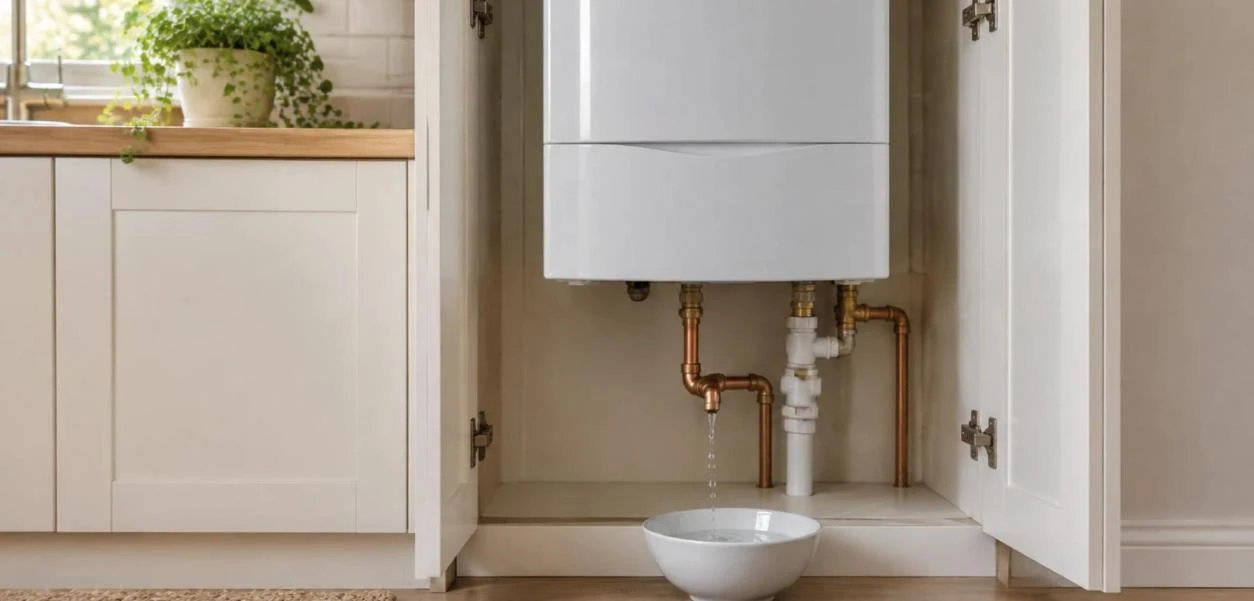
 You walk into the kitchen and find a small puddle under the boiler, or a slow drip from a pipe below it. Before you reach for a towel, it helps to know what the water is telling you.
A boiler dripping water is serious when the drip is steady, when the water comes from the casing itself, or when the boiler also shows a fault, a smell or a pressure problem. A single drop from an outside pipe after a cold night is a different case. It is worth a look, but it is not always a breakdown.
This guide explains where the water can come from, how to judge how urgent it is, what you can safely do yourself and when to call a professional.
First, find out where the water is coming from
Water under a boiler does not always come from the boiler. Pipes above it, a leaking radiator or a washing machine nearby can all end up as a puddle on the same spot.
Turn the boiler off at the switch and let it cool. Wipe the boiler and the pipes below it dry with a paper towel. Then hold a dry piece of tissue against each joint and pipe in turn, starting at the top and working down. The tissue that turns wet first marks the source.
Note the colour too. Dark or rusty water usually comes from the heating circuit. Clear water may come from a drinking water pipe, and in that case shutting off the mains supply is the first move.
Common reasons a boiler drips water
Most drips come from one of five places. Each one has a different level of urgency.
- Pressure relief valve. This safety valve releases water through a small copper pipe that runs outside when the pressure climbs too high. A drip here often means the system pressure is above about 3 bar. It can also mean the expansion vessel has lost its air charge.
- Condensate pipe. A condensing boiler makes acidic water as a by-product, and it leaves through a plastic pipe. A leak or a blockage here can send water back toward the boiler. In freezing weather, this pipe is the usual suspect.
- Worn seals or joints. Pump seals, valve washers and pipe joints wear out. These leaks tend to be slow, and the damp patch grows over weeks.
- Heat exchanger or internal pipework. Corrosion inside the boiler can open a leak that shows at the bottom of the casing. This one needs an engineer.
- Filling loop. The flexible hose that tops up the system can drip if it is left connected or if its valves do not close fully.
For example, water dripping from the outside copper pipe on a day when the pressure gauge reads 3 bar points to the relief valve. A trickle from the white plastic pipe on a frosty morning points to the condensate line.
How serious is it? A quick way to judge
Two things matter most: how much water, and what the boiler is doing.
Say you put a cup under a drip and it stays almost empty after an hour. That is slow, and it is unlikely to cause immediate damage. Say instead that the cup fills in ten minutes. Water at that speed can soak a floor and reach electrics quickly, so treat it as urgent.
Look at the display as well. A fault code, a flashing light, a drop in pressure or a boiler that keeps shutting down alongside the drip suggests a developing fault. A boiler that runs normally with one occasional drop is less worrying, though it still deserves a check at its next service.
Smell matters most of all. If you smell gas, treat that as a separate emergency. Do not switch anything on or off, open the windows and call the National Gas Emergency Service on 0800 111 999.
What you can safely do yourself
A few checks are safe for most homeowners. None of them involves opening the boiler.
- Switch off the boiler and the heating, then let everything cool down.
- Look at the pressure gauge. A cold system normally reads between 1 and 1.5 bar. A reading near 3 bar is too high.
- Check the filling loop. Make sure it is disconnected or that both valves are fully closed.
- Look at the plastic condensate pipe on a frosty day. If it is frozen, warm water poured gently along the pipe can thaw it. Never use boiling water.
- Take photos of the leak, the gauge and any fault code. A plumber can judge a lot from them.
If you reduce a high pressure, bleed a little water from a radiator while the system is cold and watch the gauge fall. Stop as soon as it reaches about 1.2 bar.
What not to do
Some quick fixes make a leak worse or put you at risk.
Do not remove the boiler casing. Inside, there are gas and electrical parts that only a registered engineer should handle. Do not plug a pressure relief pipe, since that valve exists to protect the system. And do not keep topping up the pressure every few days while ignoring the cause, because that adds fresh water and speeds up corrosion.
Bathroom sealant and tape around a leaking joint might hide a drip for a day, but they do not repair it. The water usually finds another way out.
When to call a professional
Call an engineer without delay if the water comes from inside the casing, if the drip is steady, if the boiler has locked out, or if water has touched electrics. In the same way, a pressure that keeps climbing or falling needs proper diagnosis.
Gas boilers must be worked on by a registered engineer. A local team such as Olia’s Plumbing & Heating, a Gas Safe registered team for boiler repair in London can look at a dripping boiler, find the source and explain the repair before work starts. That helps you decide what is worth fixing and what is not.
When you call, have these details ready: the boiler make and model, where the water appears, the pressure reading and any fault code. Photos help a lot.
What a repair usually involves
Knowing the typical steps makes a quote easier to judge.
The engineer first isolates the boiler and confirms where the water starts. A relief valve drip often leads to a check of the expansion vessel and the system pressure. A frozen or blocked condensate pipe is cleared and, where possible, rerouted or insulated so it does not freeze again. Worn seals and washers are replaced. If the heat exchanger has failed, the conversation moves to whether repair makes sense or whether a replacement is the better use of money.
After the repair, the engineer refills the system, checks the pressure and runs the boiler to confirm the leak has stopped. Ask what was changed and keep a note of it.
Preventing drips in London homes
Many London homes have older systems, long pipe runs and boilers fitted in cupboards or lofts, where a slow leak can go unseen for weeks. A few habits help.
Book an annual service, since an engineer will spot worn seals and low expansion vessel pressure before they leak. Check the pressure gauge once a month. Insulate any external condensate pipe before winter. And look under the boiler each time you clean the kitchen.
Renters should report a drip to the landlord or agent the same day, and owners should check what their insurance says about escape of water. Written notice protects you if damage follows.
Safety and limits of this guide
Hot water can scald, and heating water often contains dark sludge. Wear gloves, keep children and pets away and let the system cool first.
Water and electricity do not mix. If water has reached a socket or the boiler’s wiring, switch off the power at the consumer unit and do not use the boiler until a qualified person has checked it.
This guide cannot diagnose your boiler. Pressure readings, photos and the speed of the leak help a professional, but they do not replace a visit. If you are unsure at any point, stop and call for help. For any work on a gas appliance, check that the engineer is on the Gas Safe Register.
Most dripping boilers give a warning before they fail, so a damp patch or a falling pressure reading deserves a closer look on the day you notice it.